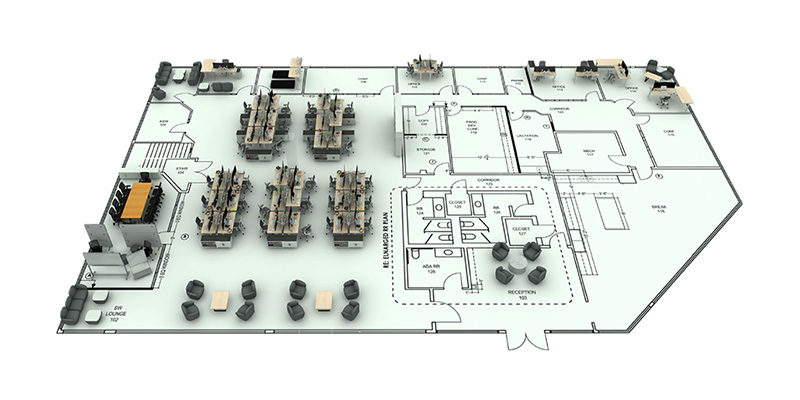
The complete office space planning guide: from corporate offices to small business floor plans
What is office space planning? Office space planning is the strategic process of designing and organizing physical work environments to maximize productivity, efficiency, and employee well-being while minimizing costs. At UPLIFT Desk, we provide free professional office space planning services for orders of 4+ desks, helping SMBs and enterprises optimize their workspace without typical consulting fees.
Key takeaway
Strategic office space planning directly impacts productivity, operational costs, and employee satisfaction by creating environments that support natural workflows and eliminate common workplace inefficiencies.
Why office space planning matters for business success
Office space planning impacts every aspect of business operations. Poor office space management reduces productivity through inefficient layouts, increases employee turnover due to uncomfortable working conditions, and wastes money through suboptimal space utilization. Research from Texas A&M University reveals that poor environmental conditions in the workplace can reduce employee productivity by up to 10%¹, while enhanced indoor air quality can increase cognitive function by 61 to 101% depending on the level of enhancement¹.
The modern workplace demands thoughtful design that balances collaboration needs with focused work requirements. According to the International WELL Building Institute, the U.S. loses more than 175 million workdays and $150 billion every year from sickness-related absenteeism¹, much of which stems from poor workplace environments.
Well-executed workspace planning delivers benefits across multiple areas of business performance. Productivity improvements come from eliminating workflow bottlenecks and reducing distractions through strategic layout design. Cost optimization maximizes value from every square foot of real estate investment. Employee satisfaction increases in work environments that support daily tasks without friction.
Employee retention improves when workers feel their physical environment supports their success. Companies with well-planned offices report lower turnover and higher job satisfaction scores. A JLL survey found that 71% of workers want office spaces that promote health and well-being, yet only 21% report their employer provides acceptable health solutions in their work environment¹. Collaboration becomes more natural when spaces are designed to facilitate both planned meetings and spontaneous interactions while still providing quiet zones for concentrated work.
Whether you're designing an office space from scratch or optimizing existing corporate office space, strategic planning is essential for business growth and employee satisfaction.
Common space planning mistakes
Understanding what not to do is equally important as knowing best practices. These common mistakes can derail productivity and waste significant resources, often requiring expensive corrections within the first two years.
|
Generic layouts without employee input Ignoring employee workflows and preferences typically leads to major redesign expenses and productivity losses. Conduct employee surveys and workflow analysis before making design decisions. |
Ignoring acoustic design Background noise and poor sound management cause widespread concentration problems, with productivity losses that compound over time. Plan acoustics with sound-absorbing materials and strategic layout from the start. |
|
Fixed, non-adaptable designs Rigid layouts that cannot accommodate growth or changing work styles require expensive redesign overhauls. Modular furniture systems and flexible layouts prevent costly renovations down the road. |
Poor technology integration Inadequate power, connectivity, and cable management create daily frustrations that add up to significant time losses for every employee. Plan technology infrastructure early, before furniture goes in. |
|
Inadequate storage planning Poor storage solutions create organizational challenges that worsen as businesses grow. Implement storage that scales with the business to maintain long-term order. |
Skipping the pilot test Rolling out a full office redesign without testing the layout with a pilot team often reveals workflow problems only after the furniture is installed. A small pilot catches issues while they're still inexpensive to fix. |
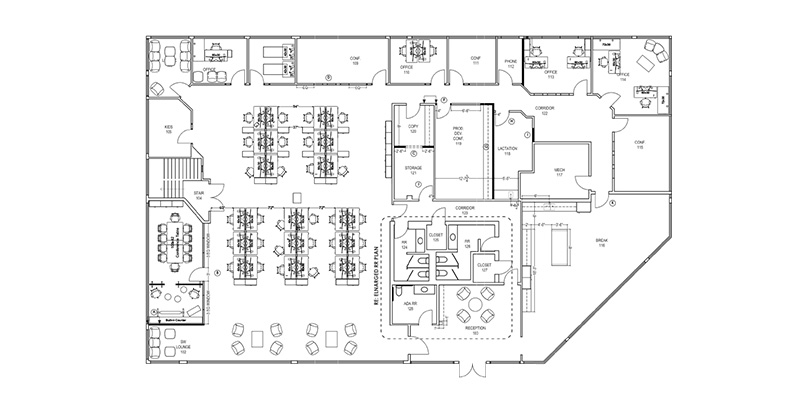
8 essential steps for effective office space planning
This office space planning guide provides proven strategies that successful businesses use to create productive work environments. From small business office floor plans to large corporate office space planning projects, these steps apply across any organization size or industry.
Step 1: Comprehensive space assessment and analysis
Before designing office space, conduct thorough analysis of current conditions. Office space optimization begins with understanding existing utilization patterns, workflows, and challenges that impact daily operations.
Essential assessment elements:
- Current headcount and realistic growth projections over the next 3-5 years
- Department-specific space requirements based on work styles and collaboration needs
- Meeting room utilization patterns across the week
- Storage needs, both active and archival
- Technology infrastructure capacity for current and future requirements
- Employee feedback on workflow challenges and space limitations
Document peak usage times and identify consistently underutilized areas. This data foundation drives all subsequent planning decisions and helps prioritize space allocation for maximum efficiency.
Step 2: Define clear space planning objectives
Effective space planning for office environments requires specific, measurable goals that align with business strategy. Whether you're planning office space for 10 or 1,000 employees, clear objectives ensure design decisions support broader organizational goals.
Productivity objectives should focus on reducing distractions, improving focus areas, and optimizing collaboration zones based on actual work patterns. Cultural goals ensure the physical environment supports company values. Operational targets include minimizing real estate costs and improving space utilization rates. Growth planning accommodates expansion scenarios without requiring major renovations.
Step 3: Strategic office layout design
Office layout planning transforms strategy into actionable design. Effective office design balances workflow efficiency, collaboration needs, and individual work preferences while maintaining flexibility for future changes.
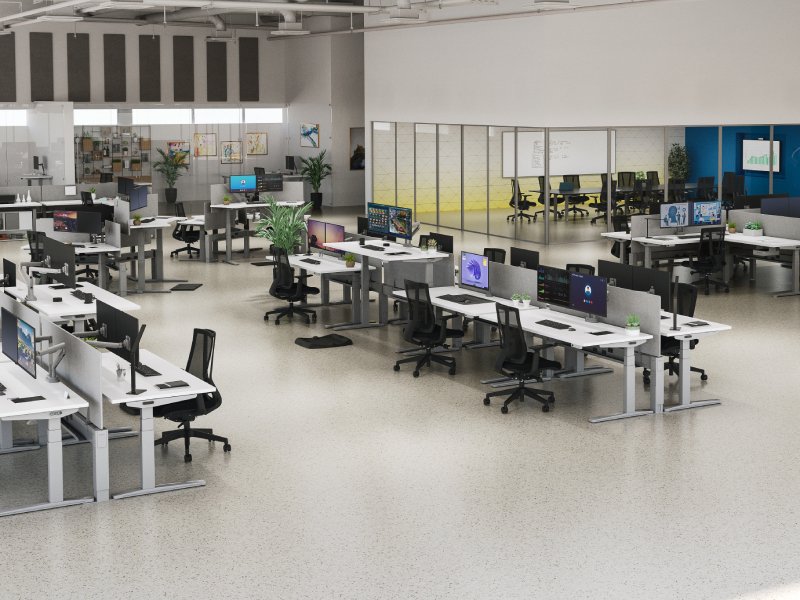
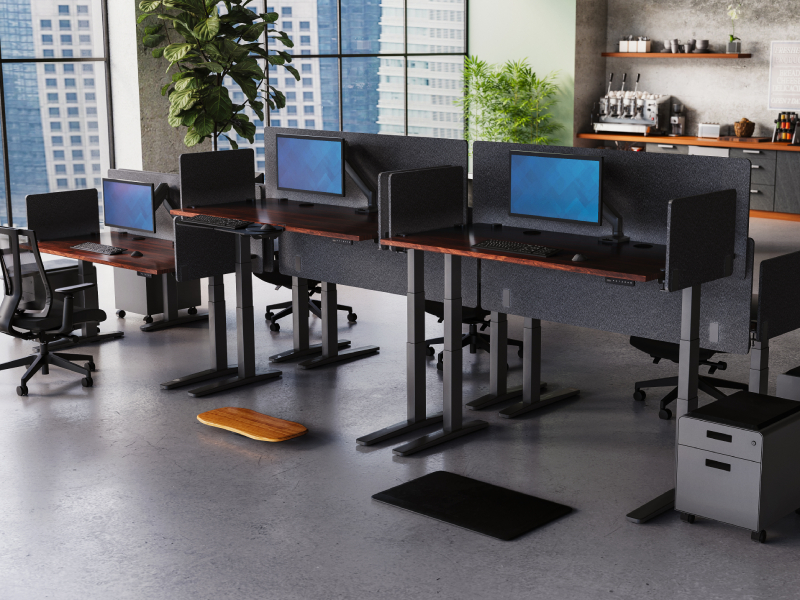
Zone-based planning creates distinct areas for focused work, collaboration, meetings, and relaxation. Traffic flow optimization positions high-traffic areas to minimize disruption to quiet work zones. Flexibility integration ensures spaces can evolve with changing business needs through modular furniture systems and moveable walls.
Strategic layout decisions significantly impact communication patterns. Research from Sheffield Hallam University found that open-plan layouts encourage communication three times more often than private offices, with conversations averaging three minutes compared to nine minutes in private offices². The same study revealed that workers in open layouts experience longer periods without communication, enabling concentrated work when needed².
Proximity planning follows the 30-meter rule², where workers are most likely to interact with colleagues within 30 meters of their workstation. Communication declines rapidly beyond that distance. Strategic placement of teams within this proximity zone enhances natural collaboration while maintaining workflow efficiency.
Biophilic design elements that integrate natural components like plants, natural light, and organic materials create measurable wellness benefits. Research by Yale Professor Stephen Kellert found that workers in biophilic environments had consistently better stress recovery responses, with participants recovering from elevated heart rate and blood pressure almost immediately after exposure to natural elements¹.
Color psychology also plays a role in workspace creativity. Calming colors like green and blue support focus and concentration, while vibrant colors like yellow, pink, red, and orange serve as sources of inspiration and energy². Strategic color application across different zones supports the work activity each zone is designed for.
Explore our acoustic solutions
UPLIFT Desk acoustic panels and color options help bring zone-based planning to life in real workspaces.
Planning for acoustics and space division
Good spacing is the foundation of a productive layout, but distance alone doesn't address sound or visual exposure. Open floor plans ask people to work in public for the entire day, and spacing by itself doesn't fix that. Acoustic treatment and space division are the layer on top of a good plan that addresses what distance can't.
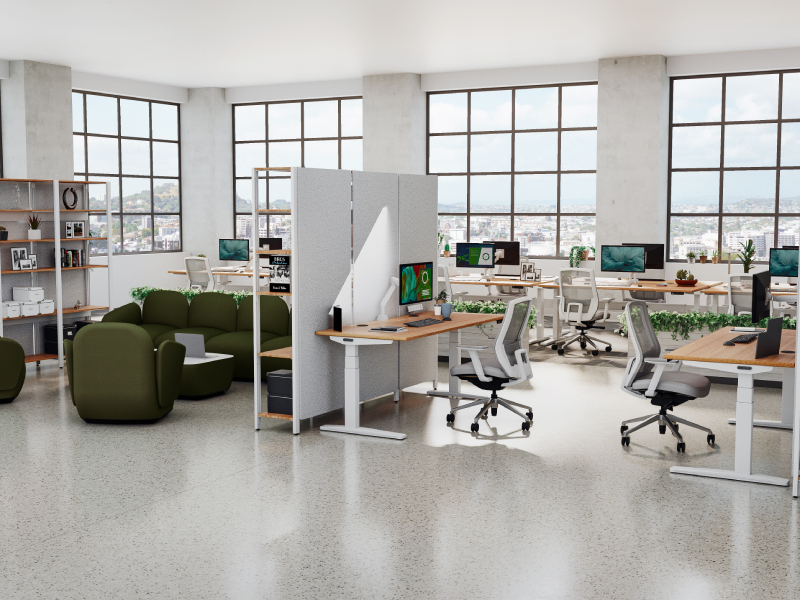
Desk-mounted acoustic panels absorb ambient sound and create a visual boundary between adjacent workstations without closing anyone off from their team. Freestanding privacy panels do the same between rows or clusters and stay light enough to reposition when layouts change. For teams that need more defined separation, mobile acoustic partitions create room-like boundaries without construction or permits.
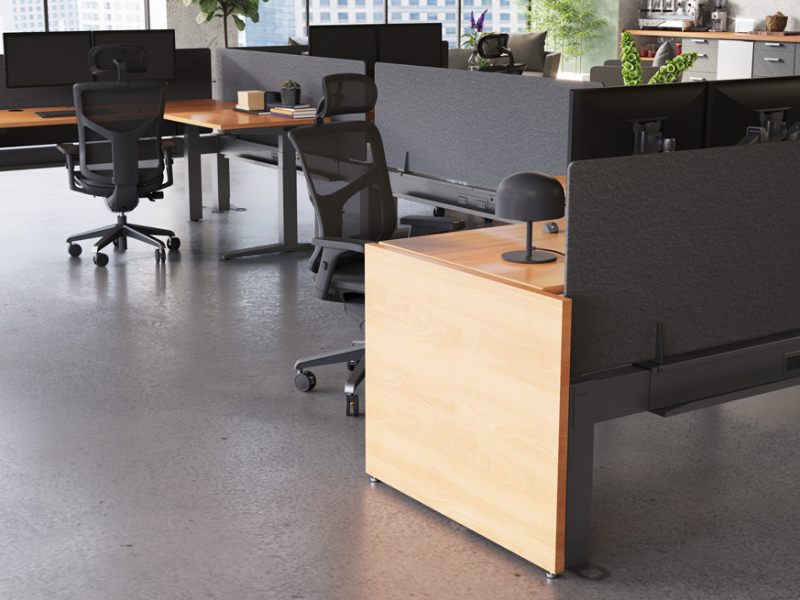
The goal is to give people room to focus and room to collaborate. Those shouldn't be competing priorities in a well-planned office.
Step 4: Strategic furniture selection and positioning
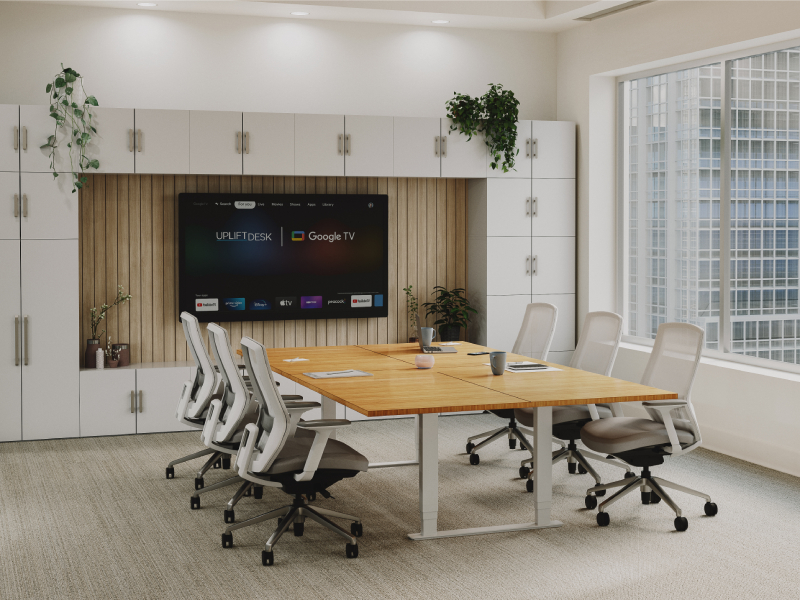
Strategic office planning balances functionality with aesthetics while ensuring every furniture piece serves a specific operational need. Desk configurations should support both individual work and team collaboration. Meeting room setups should encourage participation and productivity. Storage solutions must maintain organization and accommodate growth. Ergonomic seating supports employee health and comfort over the long workday.
Step 5: Technology infrastructure optimization
Modern workspace planning integrates technology into physical environments. Commercial space planning requires careful consideration of power, data, and lighting infrastructure that supports current operations while anticipating future technology needs.
Essential technology elements:
- Adequate power distribution with outlets and USB charging strategically placed throughout the workspace
- Comprehensive Wi-Fi coverage across all work areas
- Video conferencing capabilities integrated into meeting spaces
- Lighting design that reduces eye strain while supporting diverse work activities
- Cable management systems that keep workstations clean and organized
Learn more about our power and data solutions.
Step 6: Future-proofing and scalability planning
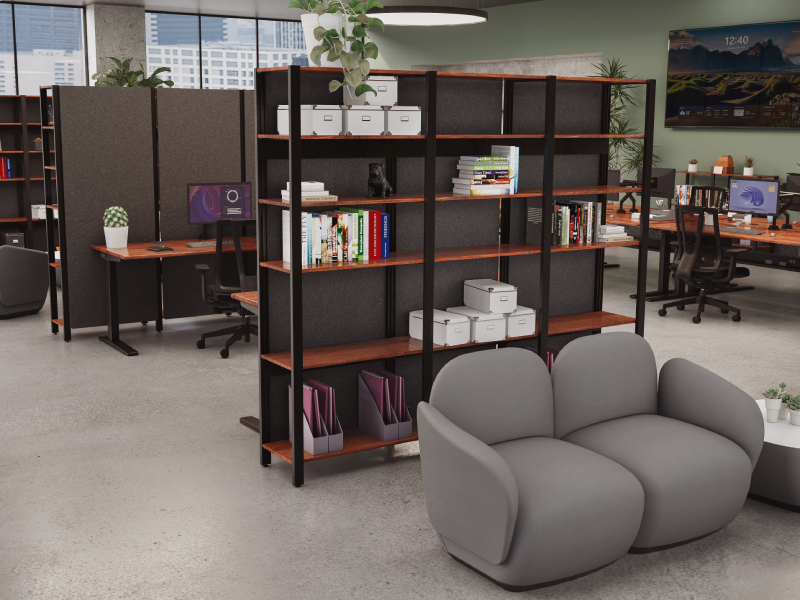
Planning office spaces for long-term success requires built-in adaptability and scalability. Modular furniture systems enable easy reconfiguration. Multi-purpose meeting spaces serve varied functions depending on the day. Scalable technology infrastructure supports growth without requiring major renovations.
Movement also encourages creativity and innovation. Sheffield Hallam University research demonstrates that workers who moved during creative tasks were substantially more creative than those who remained seated, with ideas flowing more freely and coming across as more novel². Workspace design should encourage natural movement between different zones and activity areas to stimulate creative thinking.
Step 7: Design testing and refinement
Professional office space planning services include comprehensive design testing phases. Digital mockups and 3D visualizations help stakeholders understand proposed designs before furniture is ordered. Pilot testing with a small team reveals workflow challenges before full implementation, when changes are still inexpensive to make.
Step 8: Implementation and performance monitoring
Turn office planning strategy into measurable results through phased implementation that minimizes business disruption. A phased rollout keeps the business running during the transition. Clear communication ensures all stakeholders understand the changes and timelines. Training programs cover new systems, layouts, and workflow patterns. Structured feedback collection creates a path for ongoing optimization, and regular performance reviews allow for strategic adjustments as business needs evolve.
Professional office space planning services vs. DIY solutions
Complex layouts, multi-location projects, tight timelines, or a lack of internal expertise typically warrant professional assistance. Organizations that invest in strategic planning before furniture purchases see significant cost reductions and avoid expensive post-installation modifications.
DIY approaches offer benefits including cost control, direct use of internal knowledge about workflows and culture, and the flexibility to implement gradually. Internal teams understand company culture and daily operations in ways that external consultants must learn through research and observation.
Professional service advantages include expert knowledge accumulated across multiple projects and industries, proven methodologies that avoid common pitfalls, faster implementation through experienced project management, and comprehensive solutions that address technical requirements beyond furniture placement.
Our office space planning services include free consultations for orders of 4+ desks, giving growing businesses access to professional-grade planning without the typical consulting fees.
See how businesses transformed their offices with UPLIFT Desk.
Office space planning by business type
Small business office floor plans
Small business office floor plans require maximum efficiency from limited space and tight budgets. Multi-functional furniture serves multiple purposes throughout the day. Vertical storage solutions reclaim floor space. Open layouts create a spacious feel while still preserving privacy where it matters. Flexible meeting areas accommodate a range of group sizes, and cost-effective furniture selections deliver a professional appearance without stretching the budget.
Understanding different work styles helps optimize small space design. Research identifies four types of knowledge workers²: anchors who work primarily at dedicated desks and serve as information hubs, connectors who split time between desk work and office collaboration across departments, gatherers who bring external knowledge back to process in the office setting, and navigators who work remotely but need occasional office integration and collaboration. Small businesses can design flexible spaces that accommodate these patterns without dedicated areas for each one.
Corporate office space planning
Corporate office space planning involves complex considerations including departmental workflows, executive requirements, client areas, and large-scale collaboration zones. Executive offices balance privacy with accessibility. Department-specific workspaces vary based on how each team works. Client-facing areas create first impressions that shape business relationships.
Large-scale corporate environments benefit from applying the 30-meter communication rule² when positioning departments and teams. Strategic placement within this proximity zone enhances natural collaboration while maintaining workflow efficiency across different business functions.
Coworking space planning
Coworking space planning accommodates diverse work styles and varying occupancy levels within shared environments. Success requires variety in workspace options, flexible booking systems, community areas that encourage networking, professional amenities, and scalable infrastructure that supports membership growth.
Measuring office space planning ROI
Strategic office space planning delivers tangible returns through improved workflows, optimized costs, and an enhanced workplace experience. Healthy building solutions show measurable financial benefits, with potential productivity gains of up to $200 billion annually through strategic workplace design that reduces sick building syndrome symptoms for office workers¹.
Companies that prioritize professional space planning typically see meaningful improvements across productivity, space efficiency, employee satisfaction, retention, cost optimization, and collaboration. Buildings with health-conscious design features also command higher rents, with research showing premium increases of 4.4 to 7.7% per square foot compared to standard office environments¹.
Learn more about the ROI of professional space planning.
Professional office space planning services from UPLIFT Desk
Ready to optimize your workspace? UPLIFT Desk offers free professional office space planning services for orders of 4+ desks. Our team assesses your current space, understands your specific objectives, and creates a customized plan that maximizes productivity within your budget.
Our comprehensive free service includes:
- Complete space assessment and utilization analysis
- Custom floor plan design and layout optimization tailored to your operational needs
- Strategic furniture selection and positioning recommendations
- Technology and infrastructure planning guidance for current and future requirements
- Detailed implementation timeline with progress updates and milestone tracking
- Ongoing consultation and adjustment recommendations as your workspace evolves
Contact UPLIFT Desk today to schedule your free consultation and see how strategic office space planning transforms workplace productivity and employee satisfaction while supporting your business growth.
Summary
Effective office space planning combines strategic assessment, thoughtful design, and professional implementation to create workspaces that drive business success. Whether you need small business office floor plans or comprehensive corporate office space planning, the investment in professional planning delivers measurable returns through improved productivity, reduced costs, and better employee satisfaction. Strategic planning before furniture investment prevents costly mistakes while ensuring your workspace supports both current operations and future growth.
Learn more about UPLIFT for Teams and our workspace solutions for businesses.
Sources
¹ Texas A&M University Real Estate Research Center. "Workplace Wellness: How Healthy Work Environments Can Benefit Tenants and Brokers." 2024. https://trerc.tamu.edu/article/workplace-wellness-how-healthy-work-environments-can-benefit-tenants-and-brokers/
² Sheffield Hallam University. "Enhancing Creativity Through Workspace Design." 2018. https://shura.shu.ac.uk/24896/3/Suckley%20Enhancing%20Creativity%20Through%20Workspace%20Design.pdf
Work better. Live healthier.