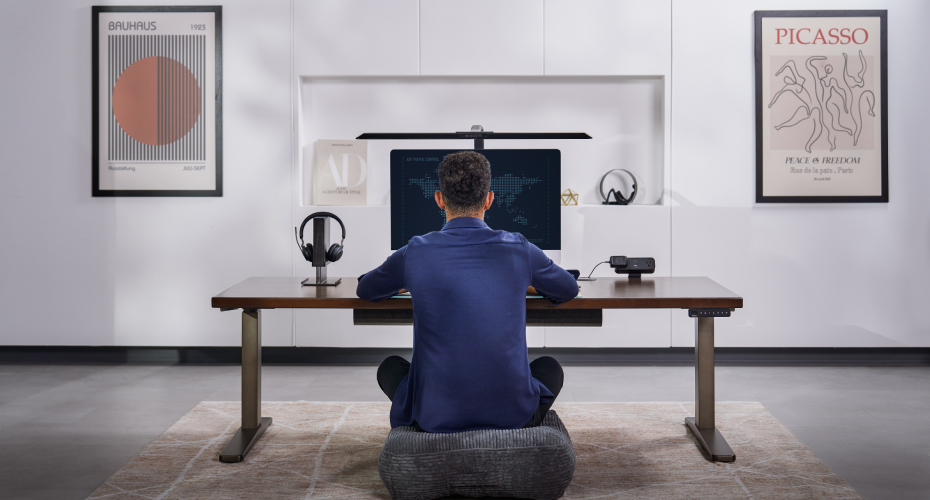
The Unexpected Sleep Benefit of an Ergonomic Workspace
Most people searching for better sleep start in the bedroom — adjusting the thermostat, cutting screen time before bed, or swapping their pillow. Rarely does anyone point the finger at their desk. But if you spend eight or more hours a day at one, the workspace itself may be quietly undermining the quality of sleep you get every night.
The connection isn't obvious at first, but it follows a straightforward chain. Poor ergonomics leads to chronic musculoskeletal pain, and chronic pain is one of the most well-documented disruptors of healthy sleep. Fix the ergonomics, reduce the pain, and you may find that better sleep follows.
What poor ergonomics does to your body
Before understanding the solution, it helps to understand the problem. Poor ergonomics doesn't announce itself dramatically. It accumulates quietly — a dull ache in the neck by mid-afternoon, tightness across the upper back by the end of the day, wrist discomfort that lingers into the evening. Most people chalk it up to stress or aging. Often, the culprit is a workstation that doesn't fit the person using it.
Common offenders include a monitor positioned too low, a desk height that causes the shoulders to hunch, and extended periods of static sitting with no postural variation. None of these feel catastrophic in the moment but over time they place continuous stress on muscles, tendons, and joints.
Here's a quick contrast between what poor and proper ergonomics look like in practice. For a deeper dive, visit the UPLIFT Desk guide to ergonomics.
The cumulative effect of getting these details right is a body that finishes the workday with some energy left, instead of carrying physical tension into the evening.
The pain connection
When your body holds awkward or static positions for prolonged periods, it strains. Muscles tighten, joints compress, and over time those repeated micro-stresses compound into something more persistent. For office workers, chronic musculoskeletal pain most commonly settles in the neck, shoulders, upper back, and wrists. It rarely arrives dramatically. It builds gradually, until one day it's just there — a low-grade constant that most people have learned to work around rather than address.
The research on this is clear. A randomized controlled trial followed office workers assigned to either an ergonomic workstation intervention or a control group over 36 weeks. Workers in the ergonomic group showed significantly lower pain intensity in the neck, shoulder, upper back, and wrist compared to the control group.1 The intervention was rooted in thoughtful workstation adjustment based on each individual's physical measurements. Proper ergonomics doesn't just prevent pain from getting worse. It actively reduces pain that's already present.
For most people, this type of chronic, low-level pain is so normalized that it stops registering as a health issue. But the body keeps score. And the consequences extend well beyond the workday.
What pain does to your sleep
A large-scale national study drawing on data from over 161,000 U.S. adults found that chronic pain was consistently associated with difficulty falling asleep, staying asleep, and waking up feeling unrestored.2 The relationship held true across age groups and genders, growing stronger when pain was present in multiple body regions. This is exactly the pattern seen in people with poor workplace ergonomics, who often carry simultaneous tension in the neck, shoulders, and back.
The neurological side of this connection is equally compelling. Research found that sleep deprivation reduces the brain's supply of a key pain-regulating neurotransmitter, making the same level of physical pain feel more acute the following day.3 Pain disrupts sleep. Disrupted sleep amplifies pain. The cycle reinforces itself, making it difficult to escape without addressing the underlying source.
A separate narrative review confirmed this bidirectional relationship at a neurochemical level, noting that the interaction between pain and sleep involves multiple overlapping systems that regulate both pain perception and sleep architecture simultaneously.4 When pain keeps these systems chronically dysregulated, the result isn't limited to a bad night here and there. Sleep quality becomes structurally compromised over time.
For office workers carrying daily musculoskeletal tension from a poorly set up workstation, this isn't a hypothetical. It's a cycle many are already caught in, often without realizing that the source is eight hours spent at the wrong desk height.

The ergonomic workspace as a sleep solution
Poor ergonomics and chronic pain are closely linked, and the relationship between chronic pain and sleep runs deep. Addressing workplace ergonomics won't cure insomnia or guarantee eight hours of deep sleep, but eliminating a persistent source of daily pain removes one of the most significant barriers.
Building an ergonomic workspace starts with a standing desk that allows you to move between sitting and standing throughout the day. Static postures place sustained load on the musculoskeletal system regardless of whether you're sitting or standing. Movement is what gives you relief. Pair this with a chair that provides genuine lumbar support, a monitor arm that lets you dial in an eye-level height, and a keyboard setup that keeps your wrists neutral.
None of this needs to happen all at once. Even incremental improvements, starting with desk height or the monitor position, compound the relief over time. The end goal is to own a workspace built around you.
Set up your workspace step by step
For a practical guide on setting up your workspace ergonomically, the UPLIFT Desk Ergonomic Workspace Setup guide walks through each component in detail, from desk and chair to monitor and keyboard.
Conclusion
A standing desk is an investment most people make for their back. What they don't expect is what happens after they leave the office. Chronic pain is one of the most consistent disruptors of sleep quality, and poor workplace ergonomics is a driver most people never consider.
Take a look at your workspace. The adjustments that make your days more comfortable may be the same ones that make your nights more restful.
Sources
1 Carneiro et al., "Effect of an ergonomic intervention involving workstation adjustments on musculoskeletal pain in office workers — a randomized controlled clinical trial," Journal of Physical Therapy Science, 2021. https://pmc.ncbi.nlm.nih.gov/articles/PMC8010160/
2 Boakye et al., "Unraveling the link between chronic pain and sleep quality: Insights from a national study," Sleep Epidemiology, 2024. https://www.sciencedirect.com/science/article/pii/S2667343624000088
3 Ghose, Tia. "Researchers find link between poor sleep and chronic pain," Harvard Gazette, 2023. https://news.harvard.edu/gazette/story/2023/11/researchers-find-link-between-poor-sleep-and-chronic-pain/
4 Yin et al., "Sleep disorders in chronic pain and its neurochemical mechanisms: a narrative review," Frontiers in Neuroscience, 2023. https://pmc.ncbi.nlm.nih.gov/articles/PMC10267346/
Work better. Live healthier.