How your workspace affects your mental health
Workplace mental health is a broad topic. Most of the conversation centers on workload, management, and culture. Ergonomics is less often part of that discussion. The way your workspace is configured has a direct and measurable effect on stress levels, fatigue, and how much mental energy you have available throughout the day.
Research published in Applied Ergonomics1 puts a number on it. Inadequate workplace conditions reduce objective cognitive capacity by an average of 2.4% to 5.8%, the equivalent of losing more than two weeks of focused work per year. In rare cases, that figure approaches 15%. Physical comfort and cognitive performance share the same inputs. When the work environment generates constant friction, cognitive capacity absorbs the cost.
What staying still actually does to your brain
Being locked into a single position for hours forces the body into continuous muscular tension. Muscles that should be cycling through engagement and rest stay loaded. Over the course of a day that becomes fatigue, and over the course of a week it becomes the kind of physical depletion that doesn’t fully resolve overnight.
A 2018 study published in The BMJ2 by Edwardson et al. examined what happened when office workers were given height-adjustable workstations through Britain’s Stand More AT Work program. The intervention wasn’t a wellness program, a coaching initiative, or a behavioral mandate. It was simply giving people the ability to change position. After 12 months, participants reported significantly lower occupational fatigue, reduced daily anxiety, and measurable improvements in overall quality of life. The variable that changed was access to movement, nothing else.
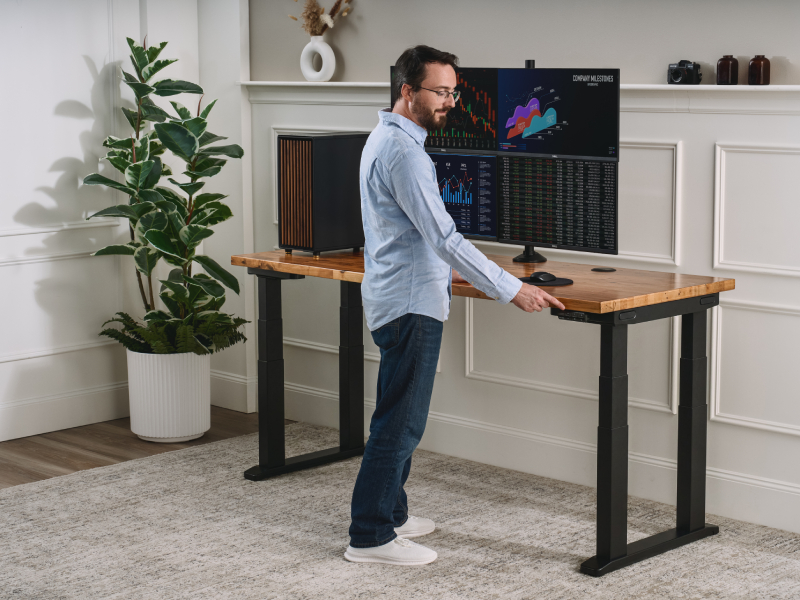
Understanding why movement produces these results matters. When the body is held in a fixed position, muscles that aren’t actively engaged begin to fatigue, triggering a low-grade stress response that the brain registers and processes continuously. That processing isn’t free. It draws on the same cognitive resources used for focus, problem solving, and emotional regulation. Introducing regular postural transitions — even minor ones — interrupts that cycle before it compounds.
What the body carries, the mind pays for
Physical discomfort that goes unresolved accumulates, and the byproduct is a taxed nervous system. If you spend the day managing low-grade strain at your desk, that strain doesn’t clock out when you do. The irritability after a long day at a poorly configured desk, the difficulty switching off, arriving home mentally bankrupt. All of it traces back to an environment that never gave the body a chance to recover.
This is where ergonomics intersects with burnout in a way that rarely gets named. Burnout has a physical precondition that the workspace either contributes to or removes.
What this means for employers
Ergonomic investment occupies a new category among workplace wellbeing initiatives. It works passively. Employees don’t need to opt in, attend a session, or build a new habit. The benefit is structural. A well-configured, adaptable workstation removes friction from the environment itself, which means its impact compounds daily without requiring ongoing behavioral change from the people using it. For organizations building a wellbeing strategy, ergonomic infrastructure is one of the few investments that doesn’t require employee buy-in to deliver value.
The cost of not investing is just as measurable. Chronic physical discomfort at work is a consistent predictor of presenteeism — employees who are physically present but operating below capacity. Over time, unresolved physical friction contributes to fatigue, disengagement, and attrition. The productivity loss embedded in a poorly configured workstation rarely appears on a balance sheet, but it accumulates the same way.
Adaptability is the right standard
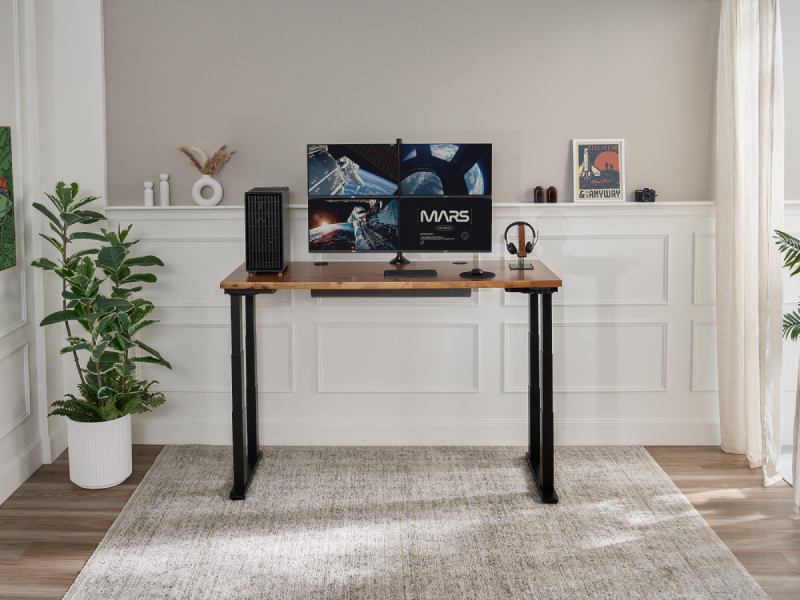
A workspace built around adaptability should account for every point of contact between you and your work. The desk gives you the range of movement. The chair conforms to the body using it. The accessories fill the ergonomic gaps in between.
A height-adjustable range wide enough to accommodate both sitting and standing, with transitions smooth enough that you’ll actually use them. Friction is the enemy of good habits. A desk that technically adjusts but requires effort to do so will stay at one height, which defeats the purpose entirely.
A chair should support a range of natural positions, not enforce a single correct one. Adjustable lumbar support, seat depth, and armrest height allow the chair to conform to the person using it, not to a standardized posture.
A truly adaptable workstation extends beyond the desk and chair. Monitor arms keep sightlines neutral as you transition between sitting and standing. Keyboard trays preserve wrist alignment across height positions. Each addition addresses a specific point of friction that, left unresolved, quietly undermines the adaptability of the entire setup.
The workstation works as a system. Investing in a height-adjustable desk without accounting for what sits on and around it addresses one problem while leaving the others in place. Dive deeper into the complete workstation ecosystem.
Build a workspace that’s optimized for adaptability, comfort, and your mental health.
At UPLIFT Desk, that’s the standard every product is built around.
Sources
1. Lamb, S. & Kwok, K.C. “A longitudinal investigation of work environment stressors on the performance and wellbeing of office workers.” Applied Ergonomics, 2016. pubmed.ncbi.nlm.nih.gov
2. Edwardson, C.L., et al. “Effectiveness of the Stand More AT Work (SMArT Work) intervention: cluster randomised controlled trial.” The BMJ, 2018. bmj.com
Work better. Live healthier.